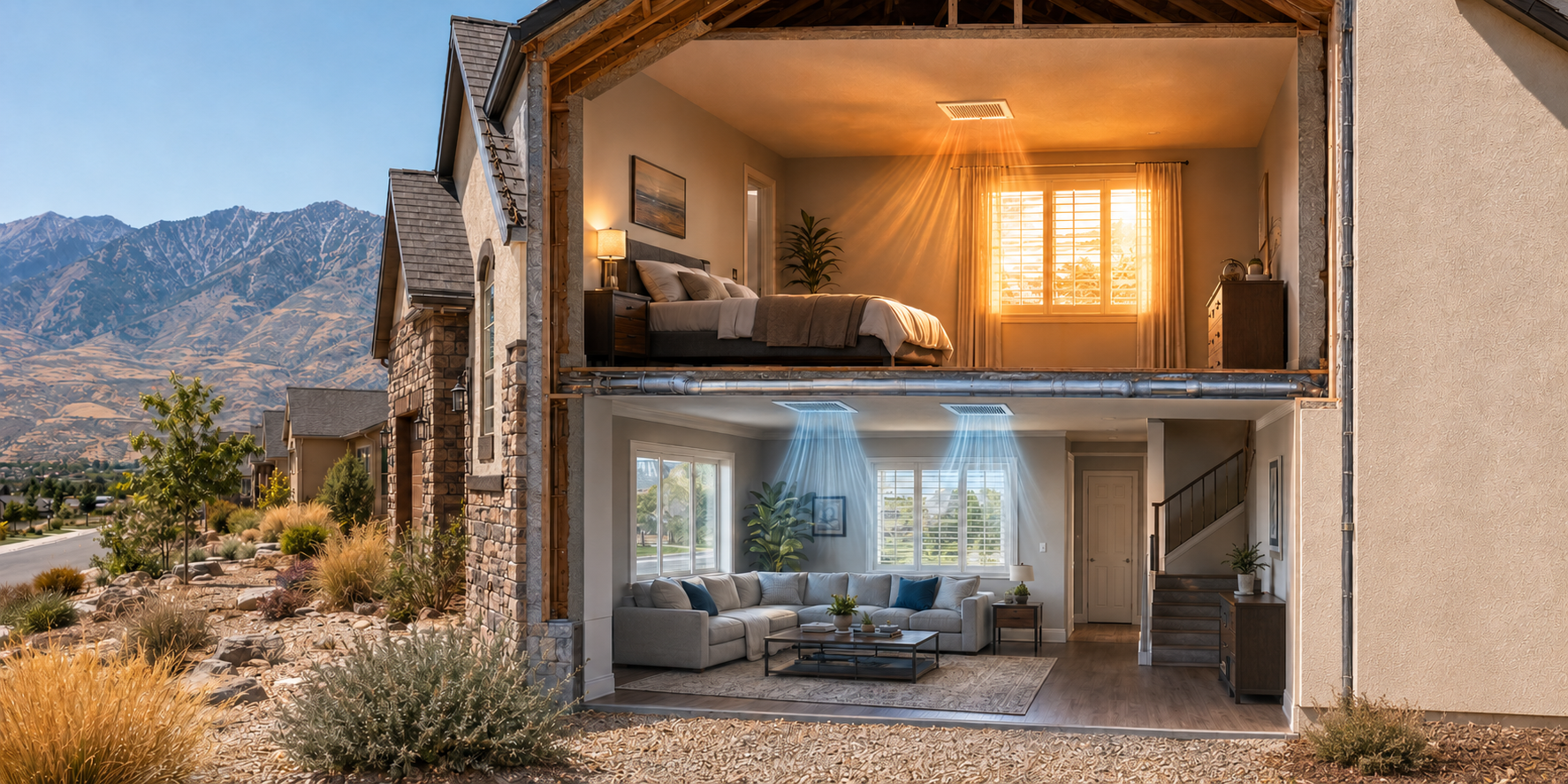
If you have ever walked up the stairs on a July afternoon and felt like you stepped into a different climate zone, you already know the problem. The thermostat downstairs reads 72 degrees, and yet the bedrooms upstairs feel closer to 80. This is one of the most common complaints we hear from homeowners across the Salt Lake Valley, and it has a name: AC not cooling upstairs.
It is not your imagination, and it does not mean your whole system is failing. At Utah Heating and Cooling, we see this in two story Salt Lake Valley homes all the time, where the upstairs level simply works against the air conditioner in ways a single-story home never has to deal with. Understanding why this happens is the first step toward fixing it instead of living with a hot second floor every summer.
Why Upstairs Rooms Get Hotter Than the Rest of the House
Heat naturally rises. In a two-story home, warm air from the main floor drifts upward and meets even more heat radiating down from the attic. That combination means the upper level fights a battle on two fronts while a single downstairs thermostat tries to average out the whole house. Many homeowners assume something is broken when really the system was never balanced for how heat behaves in a tall structure.
This shows up most during the long summer runtimes typical of our climate. When outdoor temperatures sit in the mid-nineties for days at a time, a system can run for hours without catching up on the second floor, even while the main level feels comfortable. That pattern of AC not cooling upstairs despite constant runtime almost always points to airflow and heat load, not a lack of effort from the equipment.
West Facing Rooms and Afternoon Sun
Direction matters more than most people realize. West facing rooms take the brunt of the afternoon and evening sun, and in a Salt Lake Valley summer that sun is intense. A west facing bedroom can gain several extra degrees of solar heat by early evening, right when families want to relax for the night. If your hottest room faces west, that alone can explain much of the AC not cooling upstairs pattern you notice in that particular bedroom.
Blackout curtains, solar screens, or reflective window film can reduce this solar gain significantly. The Department of Energy recommends closing curtains and installing awnings on west facing windows during the day to block heat before it enters the room. These are not permanent fixes on their own, but they take real pressure off your cooling system and speed up how quickly that room comes down in temperature.
Attic Heat Buildup Is Working Against Your System
Utah attics can reach temperatures well above 130 degrees during peak summer afternoons. That heat does not stay contained. It radiates through the ceiling into the rooms directly below, which is your entire upstairs level. Even a properly sized air conditioner has to work overtime against that kind of thermal pressure pushing down from above.
Attic heat buildup is one of the biggest hidden reasons behind a stubborn upstairs temperature problem, and it is often overlooked because homeowners focus on the AC unit itself rather than what is happening above the ceiling. Poor attic ventilation, thin or settled insulation, and gaps around recessed lighting or attic hatches all let that heat pour into the living space. The ENERGY STAR program notes that sealing air leaks and adding attic insulation can lower a home’s heating and cooling costs by an average of about 15 percent, which shows just how much impact attic conditions have on comfort.
Ductwork and Airflow Problems on the Second Floor
Even a well sized system will underperform if the ductwork feeding your upstairs rooms is not doing its job. Ducts that run through a hot attic pick up heat before the air reaches your vents, and leaky joints let cooled air escape before it gets upstairs at all. This is why homeowners tell us their system is AC running but not cooling certain rooms even though it sounds like it is working hard.
Dampers that are closed, blocked, or out of adjustment can also starve upstairs vents of airflow while the main floor gets more than its fair share. A quick inspection of your supply registers and return air paths usually reveals whether AC not cooling upstairs is a duct problem, a damper problem, or both.
Signs It Is Time to Call in a Professional
Some upstairs heat issues are easy fixes, like adjusting a damper or adding a curtain. Others point to something more serious with the equipment itself. If your system cycles constantly, blows weak airflow, or struggles more each summer, these can be early signs your AC needs attention before a small imbalance turns into a full breakdown.
An aging or undersized system always struggles most with AC not cooling upstairs complaints, since it has the least capacity to spare once heat load and duct losses are factored in. A technician can measure airflow at your registers and pinpoint whether the issue is mechanical, structural, or both.
Solutions That Actually Cool Upstairs Rooms
There is no single fix for every home, but a few approaches consistently solve AC not cooling upstairs complaints for Salt Lake Valley homeowners dealing with a hot second floor.
Zoning systems let you control upstairs and downstairs temperatures independently, so the thermostat is no longer averaging two different environments. Duct sealing and insulation address the heat gain and air loss happening inside the attic before conditioned air reaches your rooms, and the ENERGY STAR duct sealing guidance recommends sealing and insulating ductwork that runs through unconditioned spaces like attics. Attic ventilation improvements, paired with better insulation, reduce how much heat pushes down into the ceiling in the first place.
Routine AC maintenance also plays a bigger role than most homeowners expect. A system with a dirty coil, low refrigerant, or a struggling blower motor will always send its weakest performance to the farthest, hottest part of the house, which is almost always the upstairs. Keeping the equipment itself in top condition gives it a fighting chance against the attic and sun exposure working against it. Programmable and smart thermostats can also help, since the ENERGY STAR smart thermostat guidance notes that these devices can learn your schedule and automatically shift to energy saving temperatures when you are asleep or away, so the system is not caught off guard by the hottest hours of the afternoon.
Get a Cooler Upstairs This Summer
You should not have to accept a hot second floor as just part of owning a two-story home in Utah. We inspect the whole picture, including ductwork, attic conditions, insulation, and the equipment itself, to figure out exactly why AC not cooling upstairs keeps happening in your home. From there we recommend real solutions instead of a temporary patch that will not last through August.
We also work directly with homeowners on professional AC repair throughout our Salt Lake Valley service area, so whether the fix is a duct adjustment, a zoning system, or a full inspection, our team can walk you through the options that fit your home and budget. You can find current reviews on our Google Business Profile from other Salt Lake Valley homeowners who dealt with the same upstairs heat problem.
Frequently Asked Questions
Why is my upstairs so much hotter than downstairs even with the AC on?
Heat rises and collects on the upper level, and attic heat radiating through the ceiling adds even more load. With a single thermostat controlling the whole house, the upstairs almost always loses that balance in summer.
Does closing vents downstairs help cool the upstairs?
Not usually. Closing too many vents can reduce total airflow and pressure in the system, which sometimes makes AC not cooling upstairs even worse. A zoning system is a more reliable way to redirect cooling capacity.
How much does attic insulation affect upstairs temperatures?
Quite a lot. A poorly insulated attic lets heat pour directly into the ceiling of your upstairs rooms, and improving insulation is one of the most effective long term fixes.
Should I get a separate AC unit just for the upstairs?
Sometimes a ductless mini split or a zoned system is the right call, especially in older homes where the ductwork was never designed for upstairs heat loads. An evaluation can confirm if this fits your home.
Is it normal for an AC to run all day during a Salt Lake City summer?
Long runtimes are common during peak heat, but if the upstairs never reaches a comfortable temperature despite constant running, that points to airflow, duct, or attic issues.
Can duct sealing really make my upstairs rooms cooler?
Yes. Leaky or uninsulated ducts running through a hot attic lose cooled air before it reaches your vents, so sealing and insulating them often improves upstairs comfort noticeably.
What is the fastest way to find out why my upstairs is not cooling?
A professional inspection that checks airflow at each register, attic conditions, ductwork, and the equipment itself is the most reliable way to find the exact cause.