Your air conditioner stopped working on a 98-degree July afternoon in Salt Lake City. The technician gives you a repair quote and suddenly you’re wondering whether it’s worth spending that money on a system that’s been running for 12 years.
This is one of the most common questions Utah homeowners face every summer. The answer isn’t always obvious, but there are a few clear frameworks that make the decision much easier. This guide will walk you through all of them.
The 50% Rule: The Fastest Way to Decide
The HVAC industry has a simple rule of thumb that holds up well in practice: if the cost to repair your AC exceeds 50% of what a new system would cost, replacement is almost always the better investment.
Here’s why it works. A new central AC system in the Salt Lake City area typically runs between $4,500 and $8,500 installed, depending on home size, system efficiency, and any ductwork modifications needed. That means if you’re looking at a repair bill over $2,000 to $2,500, especially on a system that’s more than eight years old, the math usually favors replacement.
That said, the 50% rule is a starting point, not a final answer. Age, efficiency, and repair history all factor in too.
How Old Is Your System?
Age is the single most important variable. Most central AC units last 12 to 15 years in Utah’s climate. The dry heat, high UV exposure, and significant temperature swings from summer to winter put more wear on mechanical components than moderate climates do.
Here’s a general framework:
- Under 8 years old: Repair is almost always the right call unless the compressor has failed (see below).
- 8 to 12 years old: Apply the 50% rule carefully. Factor in how often the system has needed service in the last two seasons.
- Over 12 years old: Lean toward replacement for any repair over $500 to $800. You’re likely one or two breakdowns away from replacement anyway, and you’d be pouring money into a diminishing return.
- Over 15 years old: Replace. Even if the repair is inexpensive, a 15-year-old system is consuming significantly more electricity than a modern unit and is unlikely to last another summer without additional issues.
The Compressor Question
If your technician says the compressor has failed, that changes the calculus significantly. The compressor is the heart of your AC and it’s also the most expensive single component to replace, often running $1,200 to $2,000 in parts and labor alone.
On a system under eight years old that’s otherwise in good shape, a compressor replacement can make sense. On anything older, a failed compressor is usually a clear signal to replace the whole system. The compressor doesn’t fail in isolation. It fails because the system has been working too hard for too long, which means other components are likely close behind.
Is Your AC Losing Efficiency?
One sign that often gets overlooked: rising energy bills without a corresponding change in usage or rates.
Older AC units, particularly those installed before 2015, operate at SEER ratings of 10 to 13. Modern systems are required to meet a minimum of 14.3 SEER2 (the updated efficiency standard that took effect in 2023), and high-efficiency units routinely hit SEER2 ratings of 18 to 20+. That gap translates to real money. A system running at half the efficiency of a modern unit can add hundreds of dollars per year to your Rocky Mountain Power bill during Utah’s four to five month cooling season.
If you’re seeing energy costs climb and your system is more than ten years old, that efficiency gap is real and it’s a cost that compounds every year you delay replacement. Rocky Mountain Power’s Wattsmart residential program offers rebates for qualifying high-efficiency air conditioners installed in Utah homes, which can meaningfully offset the upfront cost of a new system. You can check current residential incentives at Rocky Mountain Power’s Wattsmart home rebates page.
How Often Has It Needed Repairs?
One repair per year on an older system is a yellow flag. Two or more repairs in a single season is a red flag and a strong argument for replacement regardless of the individual repair cost.
This is the death by a thousand cuts problem. A $350 capacitor repair in May, a $600 refrigerant recharge in July, and another service call in August can easily total more than $1,200 in a single summer. Spread across two or three seasons of similar patterns, you’ve spent enough for a new system while still living with the unreliability of the old one.
If your system has needed AC repair more than twice in the past 12 months, get a replacement quote alongside the repair estimate. You may find they’re closer than you expect.
Utah-Specific Factors to Consider
A few things make this decision slightly different in Salt Lake City and the surrounding valleys compared to the national averages you’ll read about elsewhere.
The Altitude Factor
At roughly 4,200 feet, the Salt Lake Valley’s thinner air affects how efficiently your AC unit rejects heat. Systems here run harder during the peak of summer than the same-spec unit would at sea level. That accelerates wear and means a 12-year-old Utah system may be closer to end of life than a 12-year-old system in a lower-elevation market.
Refrigerant and R-22
If your system is old enough to use R-22 refrigerant (generally pre-2010 systems), repair just became significantly more expensive. R-22 has been phased out and is now very costly when available at all. A refrigerant leak on an R-22 system is almost always a replacement trigger.
The Inversion Season
Salt Lake City’s notorious winter inversions trap particulate matter in the valley for weeks at a time, and that same air is cycling through your HVAC system. Older systems with degraded filtration and worn components don’t handle this as well. If your system has been running with reduced airflow or dirty coils, that stress compounds over time.
When Repair Is the Right Call
Repair makes clear sense when:
- The system is under 8 years old and the repair is a straightforward component failure (capacitor, contactor, fan motor, drain line)
- The repair cost is well under 50% of replacement cost
- The system has been consistently maintained and has no history of repeat breakdowns
- It’s late in the cooling season and you need a short-term fix to get through summer while budgeting for replacement next spring
When Replacement Is the Right Call
Replace your AC when:
- The system is 12+ years old and the repair quote exceeds $800 to $1,000
- The compressor has failed on any system older than 8 years
- You’ve had two or more repairs in the past 12 months
- The repair cost exceeds 50% of a new system
- The system uses R-22 refrigerant and has a refrigerant leak
- Your energy bills have been climbing without explanation
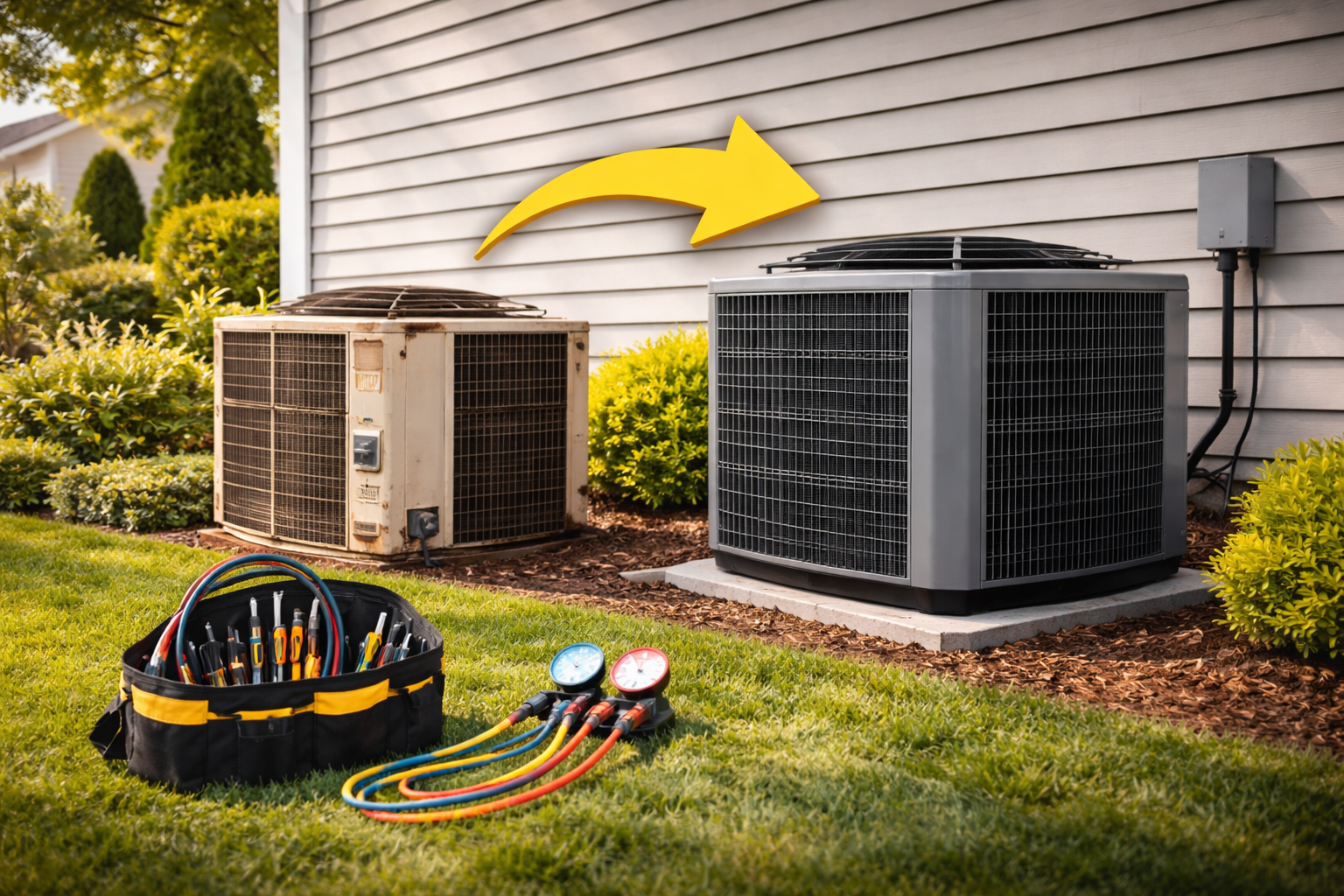
When you do replace, it’s worth choosing a properly sized, high-efficiency system rather than just the cheapest unit that fits. According to ENERGY STAR, replacing an air conditioner older than 10 years with a certified high-efficiency unit can reduce heating and cooling costs by up to 20%. You can review ENERGY STAR’s current AC efficiency ratings and guidance at energystar.gov.
Not Sure? Get a Second Opinion
If a technician is recommending a major repair on an older system, it’s completely reasonable to ask for a replacement estimate in the same visit or to get a second opinion before committing. A trustworthy contractor will walk you through both options honestly, including the long-term cost difference.
At Utah Heating and Cooling, we offer free estimates and include complimentary second opinions on repair vs. AC replacement decisions. Our technicians will show you the numbers on both sides so you can make the call that’s right for your home and budget.
Ready to stop guessing? Call us at (801) 948-0663 or get a free estimate online.